

OCD Resources
OCD FREEDOM FRAMEWORK
You are here because what you are currently doing has not been helping; in fact, you may feel like your freedom and your life are slowly being taken away from you by OCD. We have been helping people just like you or a loved one overcome OCD with our acclaimed “OCD Freedom Framework”.
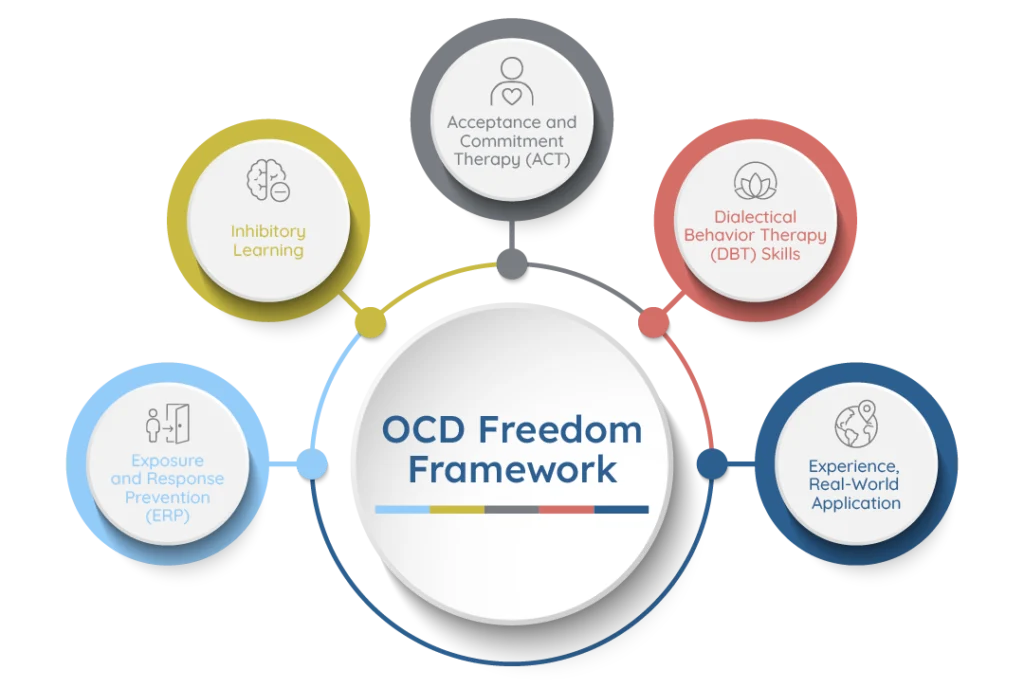
At Anxiety Trauma & Depression Treatment Centers, our Obsessive-Compulsive Disorder (OCD) Intensive Outpatient Program (IOP) integrates the “OCD Freedom Framework” five core components into a structured approach. You will learn to confront triggers safely, build enduring coping mechanisms, enhance emotional regulation, and reinforce successes in daily life that last a lifetime, all while treating the underlying anxiety causing your OCD.
OCD IOP Care Designed for Real Life
Structured support, individualized attentive guidance, and practical skills for immediate application. Our OCD IOP offers more than weekly therapy sessions. You will engage in 9 to 13 hours of programming each week, encompassing limited-sized group therapy, individual sessions, and guided practice. Care is accessible in person or virtually, allowing you to receive treatment while maintaining connections to home, school, or work. We are in-network with most major insurance providers.
You can expect:
- A clear strategy for addressing obsessions and reducing compulsions.
- Calm, step-by-step practice with experienced clinicians.
- Practical tools for challenging moments, beyond theoretical concepts.
- Small groups for more individualized attention.
- Family education and support, when beneficial.
- Consistent progress that translates to everyday living.
ERP: The Gold Standard of OCD Treatment, Facing the Fear
Component One: Exposure and Response Prevention (ERP) for OCD
ERP helps you regain control by safely confronting triggers while modifying responses.
ERP supports you in facing triggers in a controlled environment while choosing different responses. Together, we will establish a hierarchy aligned with your objectives. You will practice at your own pace, learning to manage urges without engaging in compulsions, and recognizing that anxiety naturally fluctuates. This process builds confidence gradually.
You may experience:
- Gradual challenges that respect your boundaries.
- Small, achievable steps that build momentum.
- Tangible successes, such as leaving an item unchecked or allowing a thought to pass without ritualistic behavior.
New Pathways to Living
Component Two: Inhibitory Learning for OCD
Build new, lasting learning that endures beyond treatment.
Inhibitory learning focuses on creating new neural pathways. Instead of attempting to disprove fears, you learn to tolerate uncertainty and discomfort, understanding that feared outcomes do not dictate your life. We design exposures to create strong new memories that compete with existing patterns, thereby weakening the compulsion cycle.
This often involves:
- Targeted practice for persistent triggers.
- Moments where your physiological response is steadier than anticipated.
- An increasing sense of ease with doubt and uncertainty.
We Accept Most Insurance
We are in-network with the following providers:









Learning to Live Beyond OCD
Component Three: Acceptance and Commitment Therapy
Acceptance and Commitment Therapy (ACT) is an important part of the OCD Freedom Framework because recovery isn’t about eliminating every intrusive thought or waiting until anxiety disappears. ACT helps you learn to change your relationship with thoughts, feelings, and uncertainty so they no longer control your decisions. Rather than fighting, analyzing, or avoiding unwanted thoughts, ACT teaches psychological flexibility—allowing uncomfortable experiences to be present while choosing actions based on what truly matters to you. Combined with ERP, Inhibitory Learning, and DBT skills, ACT helps you move from simply managing OCD to living a meaningful life despite uncertainty and fear. The goal is freedom: to stop letting OCD dictate where you go, what you do, and who you are—and start making choices based on the life you want to live.
Build Emotional Resilience, Learn to Trust Yourself
Component Four: Dialectical Behavior Therapy (DBT) Skills for OCD
Regulate emotions, reduce reactivity, and navigate urges effectively.
DBT provides a stable foundation to complement ERP. You will acquire practical skills for distress tolerance, mindfulness, and emotion regulation. When your physiological state is less agitated, obsessions often lessen in intensity, and resisting compulsions becomes more manageable.
You can expect:
- A toolkit for high-stress situations.
- Effective breathing, grounding, and mindfulness techniques.
- Increased self-patience and compassion for your progress.
Call Now to Get Verification of Benefits
Practice Living Again
Component Five: Experience, Real-World Application
Practice in relevant settings that translate skills into everyday successes.
We integrate practice into real-world scenarios with supportive coaching. These experiences can occur at home, in the community, or through carefully designed virtual sessions. Confidence grows as you achieve success in areas that previously felt insurmountable.
You might observe:
- Passing a sink without engaging in repetitive washing.
- Closing reassurance-seeking tabs and remaining present.
- Driving your usual route without performing mental rituals.
How the Five Components of the OCD Freedom Framework Work Together in IOP
A weekly structure that fosters confidence and resilience.
Your weekly schedule integrates ERP, inhibitory learning strategies, DBT skills, Acceptance and Commitment Therapy (ACT), and real-world practice into a cohesive plan. Group sessions normalize the experience and provide encouragement. Individual sessions personalize your exposure and coaching. This combined approach helps you understand OCD, confront it with support, and live with greater freedom.
Within the IOP framework:
- 9 to 13 hours per week of structured programming.
- Group therapy alongside weekly individual sessions.
- Step-down planning to ensure sustained gains post-program completion.
Whom Our OCD IOP Serves
Intensive Care for young adults and adults. We provide support for individuals aged 18 to 75. This level of care is suitable if you are transitioning from hospitalization or a higher level of care, require more support than weekly therapy offers, or are initiating structured treatment for the first time. We address a wide range of presentations, including contamination fears, harm obsessions, checking, symmetry and ordering, relationship OCD, intrusive thoughts, and health anxiety.
In-Person and Virtual Options
Access care wherever you are, with the same dedicated team. Choose in-person IOP at our clinics or join our secure virtual IOP. Both options follow the same evidence-based curriculum and core components. Virtual care enhances accessibility for individuals in rural areas or those with busy schedules, and it facilitates consistent practice.
Family Support and Education
Involve your support system in the process. When beneficial, we offer family education and coaching. Loved ones learn about how OCD functions, how to support ERP without inadvertently reinforcing compulsions, and how to encourage progress with understanding and patience.
Get Started with the OCD Freedom Framework Treatment Program
Call 833-803-3883 Now or Fill Out the Form