

OCD Treatment
Intensive Outpatient Programs
Young Adults & Adults
- Bountiful | Orem | West Jordan -
OCD Treatment That Works
We Understand You and How Hard It's Been

Anxiety, Trauma & Depression Treatment Center’s Intensive Outpatient Programs (IOPs) provide an individualized, comprehensive, structured approach to treating you or a loved one’s OCD, utilizing the “OCD Freedom Framework,” effectively helping people just like you manage their symptoms. This program combines the most effective therapeutic modalities such as Exposure and Response Prevention (ERP), Inhibitory Learning, Dialectical Behavioral Therapy, Acceptance and Commitment Therapy, and Experiential Therapy in group therapy and individual sessions to help you or a loved one confront their obsessive thoughts and compulsive behaviors in a controlled, intimate environment. By gradually exposing you or a loved one to feared situations and encouraging healthier coping mechanisms, our IOPs empower OCD sufferers to reduce their compulsions and anxiety. This approach helps you or a loved one build emotional resilience, develop long-term coping strategies, and improve their overall quality of life. Our IOPs also offer ongoing support and skills training to help OCD sufferers maintain progress, manage relapses, and ultimately overcome the disorder, allowing them to lead more fulfilling and successful lives. If you or a loved one has been suffering from OCD, the end can be near; call one of our admissions coordinators to start recovery.
We Accept Most Insurance
We are in-network with the following providers:









In-Network with
Select Health
Call Now to Get Verification of Benefits
OCD Treatment in Bountiful, Orem & West Jordan, Utah
Office Hours: Mon-Fri: 9am – 5pm
(By Appointment Only)
Phone: 833-803-3883 | Fax: 435-767-0278

Bountiful
596 W 750 S Suite 300
Woods Cross, UT 84010

Orem
383 N. State Street, Suite 201
Orem, UT 84057

West Jordan
9289 S. Redwood Rd., Ste. D
West Jordan, UT 84088
Virtual IOP - Now Available!
Learn More

Treatment is Here for Adolescents with OCD
Obsessive-Compulsive Disorder (OCD) in adolescents can significantly impact their daily lives and long-term mental health. During adolescence, the pressures of school, social dynamics, and self-identity development can exacerbate OCD symptoms, leading to intense cycles of intrusive thoughts (obsessions) and compulsive behaviors aimed at reducing anxiety. For many adolescents, OCD can interfere with academic performance, relationships with family and peers, and overall self-esteem. If left untreated, the disorder can persist into adulthood, often becoming more severe and harder to manage. Untreated OCD in adolescence may result in chronic mental health issues such as depression, social isolation, and increased risk for other anxiety disorders, further impairing their ability to lead a fulfilling life.

Young Adults With OCD: It's Time to Live Again

If you or a loved one is 18-24 years old, OCD can manifest in more complex and challenging ways as you or a loved one face the transition to greater independence, relationships, and career development. The compulsions that typically accompany OCD, such as repeated checking, counting, or cleaning, can interfere with academic achievements, job performance, and the ability to maintain healthy relationships. The impact of OCD may cause significant distress, leading to avoidance behaviors, lack of motivation, and feelings of hopelessness. Without proper treatment, OCD most likely is already negatively affecting you or your loved one’s personal and professional growth, increasing the risk of co-occurring disorders like depression, substance abuse, or other anxiety-related conditions. Long-term implications of untreated OCD gradually close off the world to you or a loved one, diminishing quality of life, hindering personal achievements, and decreasing overall well-being. It doesn’t have to be this way.
OCD Treatment for Adults When Traditional Therapy Hasn't Worked
Choose What You Want, Not OCD Choosing for You
If you’re an adult struggling with OCD, you may already feel exhausted by the endless cycle of intrusive thoughts, compulsions, mental checking, reassurance-seeking, and anxiety that never seems to fully shut off. Many of our patients come to treatment after years of traditional talk therapy that helped them understand their thoughts, but didn’t stop the obsessive fear or compulsive behaviors driving their distress. At Anxiety, Trauma & Depression Treatment Centers, we developed the OCD Freedom Framework that uses evidence-based therapies specifically designed to treat OCD at its root, including Exposure and Response Prevention (ERP), Dialectical Behavioral Therapy (DBT), Inhibitory Learning, Acceptance and Commitment Therapy (ACT), and our Resilience Model approach to emotional regulation and nervous system recovery. ERP is the gold standard treatment for OCD because it helps retrain the brain to tolerate uncertainty and reduce compulsive behaviors instead of reinforcing them. Combined with deeper work on emotional hijacking, distress tolerance, and avoidance patterns, this approach helps you move beyond temporary symptom management and build lasting freedom from OCD’s control over your daily lives. The OCD Freedom Framework has helped people just like you get their lives back to start living again.

Intensive OCD Treatment Using the OCD Freedom Framework
Freedom From OCD Starts Here

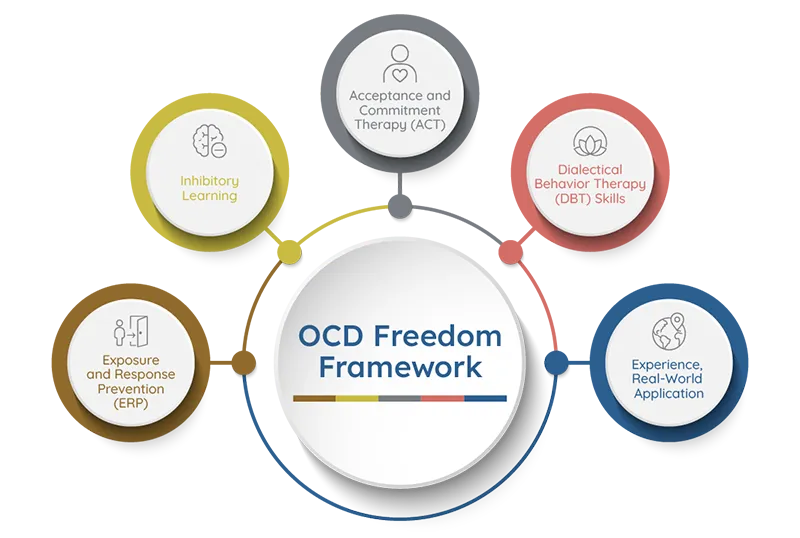
OCD makes your world smaller. Intrusive thoughts, compulsive behaviors, reassurance seeking, avoidance, and the constant need to feel certain can slowly take away your freedom, your relationships, your confidence, and your ability to simply live your life. Real progress with OCD requires more than understanding why you have these thoughts—it requires learning that you can experience uncertainty, anxiety, and intrusive thoughts without giving OCD control. Our Intensive Outpatient Program uses the OCD Freedom Framework, an integrated approach built around five core components: Exposure and Response Prevention (ERP), Inhibitory Learning, Dialectical Behavior Therapy (DBT) skills, Acceptance and Commitment Therapy (ACT), and Experiential Therapy. Together, these evidence-based approaches help you face fears, resist compulsions, tolerate uncertainty, regulate difficult emotions, and develop the confidence to respond differently when OCD tells you that you aren’t safe.
With the intensity and structure of our IOP, you have more opportunities to challenge avoidance, practice these skills, and turn treatment into meaningful change. The goal isn’t to spend the rest of your life managing OCD—it is to reclaim your freedom, rebuild the life OCD has made smaller, and learn that intrusive thoughts and fear do not have to dictate your choices. The OCD Freedom Framework is about more than treating symptoms; it’s about learning how to live again.
OCD Treatment FAQs
What OCD treatment does Anxiety Trauma & Depression Treatment Centers offer?
Anxiety Trauma & Depression Treatment Centers provides intensive OCD treatment designed for people whose symptoms are interfering with their relationships, work, school, or ability to enjoy everyday life. Treatment incorporates Exposure and Response Prevention (ERP), Inhibitory Learning, Dialectical Behavior Therapy (DBT) skills, Acceptance and Commitment Therapy (ACT), and real-world experiences to help patients develop new ways of responding to intrusive thoughts, anxiety, uncertainty, and compulsions.
What is the OCD Freedom Framework?
The OCD Freedom Framework is the specialized approach used to help patients move beyond the cycle of obsessive thoughts, anxiety, avoidance, and compulsions. It combines five complementary pillars: ERP, Inhibitory Learning, DBT Skills, ACT, and Experiences. The goal is not simply to reduce OCD symptoms but to help patients develop the skills and confidence to face uncertainty, resist compulsions, and begin living according to their values again.
Why is the OCD Freedom Framework so effective?
The OCD Freedom Framework brings together several complementary evidence-based approaches rather than relying on one technique alone. ERP helps patients face feared situations while resisting compulsions. Inhibitory Learning focuses on developing new learning that challenges OCD’s predictions. DBT skills help patients tolerate distress and regulate difficult emotions. ACT teaches patients to accept unwanted thoughts and feelings without allowing them to control their behavior. Finally, real-world experiences give patients opportunities to practice these skills outside the therapy room. Together, these pillars provide a comprehensive approach to helping patients move from simply managing OCD toward reclaiming their freedom and their lives.
What is ERP and why is it important for OCD treatment?
Exposure and Response Prevention (ERP) is one of the most established behavioral treatments for OCD. ERP involves gradually confronting thoughts, situations, sensations, or uncertainties that trigger OCD while learning to resist compulsions and avoidance. With appropriate guidance and repetition, patients can learn that they can experience anxiety and uncertainty without having to perform compulsions to feel safe.
What is Inhibitory Learning for OCD?
Inhibitory Learning is an approach that focuses on creating new learning that competes with the fear-based predictions created by OCD. Instead of requiring someone to become completely comfortable before moving forward, treatment helps them discover through experience that feared outcomes may not occur and that they can tolerate uncertainty even when anxiety is present. Inhibitory Learning works particularly well alongside ERP because patients have repeated opportunities to create new experiences that challenge what OCD has taught them to fear.
How does ACT help people with OCD?
Acceptance and Commitment Therapy (ACT) helps people change their relationship with intrusive thoughts, anxiety, and uncomfortable emotions. Rather than spending their lives trying to eliminate every unwanted thought or achieve complete certainty, patients learn to allow difficult internal experiences to exist while choosing actions based on their personal values. ACT can help someone move from asking, “How do I make this thought go away?” to “What do I want to do with my life even when this thought is here?”
How can DBT skills help with OCD?
OCD can create intense anxiety and emotional distress, particularly when someone begins resisting compulsions. DBT skills can provide practical tools for managing those difficult moments. Skills related to distress tolerance, emotional regulation, mindfulness, and interpersonal effectiveness can help patients stay engaged in treatment and respond to anxiety without automatically returning to compulsive behaviors or avoidance.
Why is intensive OCD treatment sometimes better than weekly therapy?
Weekly therapy can be helpful, but some people need more frequent treatment when OCD symptoms are severe, persistent, or significantly interfering with daily life. Intensive treatment provides more opportunities to practice ERP, develop coping skills, challenge avoidance, and apply treatment strategies between sessions. For someone who has been in traditional therapy but isn’t making the progress they need, an intensive program can provide the structure and frequency necessary to take treatment to the next level.
Who is a good candidate for intensive OCD treatment?
Intensive OCD treatment may be appropriate for someone whose obsessions or compulsions are significantly affecting daily life or who has not made sufficient progress through traditional outpatient therapy. It may also be appropriate for someone who needs more structured support while learning and practicing ERP and other OCD-specific skills. An individualized assessment can help determine whether intensive treatment is appropriate.
Does OCD treatment focus on getting rid of intrusive thoughts?
Not necessarily. A major goal of effective OCD treatment is learning that you don’t have to control, eliminate, analyze, or neutralize every intrusive thought. Intrusive thoughts are a common human experience, but OCD can cause people to assign excessive meaning or importance to them. Treatment helps patients develop a different response to those thoughts so they no longer have to dictate their behavior.
Will ERP make my anxiety worse?
ERP intentionally involves facing situations or thoughts that can initially produce anxiety. However, the purpose isn’t to overwhelm someone or force them through experiences they aren’t prepared to handle. ERP is typically gradual and individualized, with the goal of helping patients learn that anxiety and uncertainty can be tolerated without performing compulsions. The treatment process is structured around learning new responses rather than simply enduring distress.
Can OCD treatment help with reassurance seeking and avoidance?
Yes. Reassurance seeking and avoidance can become part of the OCD cycle, even when they don’t look like traditional compulsions. OCD treatment can help patients identify these patterns and practice responding differently. Through ERP, Inhibitory Learning, ACT, DBT skills, and real-world practice, patients can begin facing uncertainty without repeatedly seeking reassurance or avoiding situations that trigger OCD.
Can I continue working or going to school while receiving OCD treatment?
One of the benefits of an intensive outpatient approach is that patients can receive a higher level of therapeutic support while continuing to live at home and participate in their everyday environment when clinically appropriate. This also provides opportunities to practice OCD treatment skills in real-world situations, rather than only discussing them inside a therapist’s office.
How long does OCD treatment take?
There is no single treatment timeline that works for everyone. The length and intensity of treatment depend on factors such as the severity of OCD, the types of obsessions and compulsions present, previous treatment experiences, and the individual’s response to therapy. OCD treatment is a process of learning and practicing new responses, and progress can continue as patients apply those skills in everyday life.
Can OCD treatment really help me get my life back?
Yes. OCD treatment isn’t simply about learning how to tolerate symptoms—it is about reclaiming the ability to make choices without OCD running your life. The OCD Freedom Framework is designed to help patients face fear, tolerate uncertainty, resist compulsions, develop emotional resilience, and reconnect with the activities and relationships that matter to them. The goal is not to wait until every intrusive thought disappears before you start living. The goal is to learn how to live again, even when uncertainty and uncomfortable thoughts are present.
Get The OCD Treatment You Deserve Today
Call 833-803-3883 Now or Fill Out the Form Below